




Medically reviewed by Dr. Thu T. Pham, M.D., of Nova Eye Experts.
There’s no ripeness test
A lot of people are waiting for someone to tell them their cataract is “ripe.” That day doesn’t come. Current guidance from the American Academy of Ophthalmology puts it plainly: you should consider surgery when a cataract keeps you from doing the things you want or need to do.
Which means the answer mostly lives in your life. If the cataract isn’t bothering you much, you don’t have to remove it. If it is, you don’t have to wait for it to get worse.
There’s one caveat. Dr. Pham does tell some patients not to wait too long, because a cataract can get physically hard and dense, and a dense cataract carries a higher risk of complications. She’ll sometimes tell patients in their eighties to go ahead while they’re healthy, so they get more years of good vision out of it. Most of the time, though, timing comes back to how much the cataract gets in the way of your day.
1. What have you quietly stopped doing?
Start here, because cataracts are sneaky about it. They develop slowly, and people adjust without noticing they’re adjusting.

You stopped reading in bed because the lamp never seems bright enough. You let your spouse drive to dinner in Old Town Warrenton. You haven’t done the crossword in a year, or you’ve started holding the seed catalog at the window to read it. You skip the Friday game at the Culpeper high school because the stadium lights make everything smear.
None of those feels like a medical symptom. Each is a small retreat. Add them up honestly and you have most of your answer.
Then ask the reverse. What are you working around? Brighter bulbs in every room. A magnifier by the pill bottles. Turning your head to get the glare out of the way. Workarounds are fine, and they’re what’s recommended early on. But when your house is full of them, the cataract is already running your routine.
2. How is driving after dark?
For a lot of people in Fauquier County, this is the question that settles it.
Cataracts scatter light. Headlights bloom into halos, streetlights streak, and an oncoming pickup on Route 17 turns the whole windshield white for a second or two. You might still read the chart fine in a bright exam room and feel unsafe on an unlit two-lane road at 9 p.m.
There’s a legal line here too. In Virginia, an unrestricted driver’s license requires 20/40 vision or better in one or both eyes. Between 20/40 and 20/70, the license can be restricted to daylight hours. If you’ve started timing errands around sunset, you’re already living with a daylight-only license. You just haven’t been issued one.
3. Have new glasses stopped helping?
Early on, a stronger prescription can fix things. That’s the AAO’s advice for a mild cataract: update your glasses, use brighter light for reading, wear sunglasses against glare.

The sign to watch for is the pattern. A prescription that changes every year. A new pair that’s great for a month and then isn’t. Readers you keep buying a notch stronger. Needing frequent prescription changes is one of the symptoms NOVA Eye Experts lists for cataracts, and it makes sense: a cataract can shift how your eye focuses as it develops, and glasses can only chase that so far.
If you’ve bought three pairs of glasses in two years and none of them feels right, the glasses aren’t the problem.
4. Is anything else going on in your eyes?
This one’s mostly about how the surgery should be planned. Sometimes it changes the timing too.
Glaucoma is the clearest case. Dr. Pham offers cataract surgery sooner when glaucoma isn’t well controlled, because cataract surgery, alone or combined with MIGS (minimally invasive glaucoma surgery), can improve both vision and eye pressure. The same goes for narrow angles, where the eye’s drainage angle is crowded. A laser procedure called LPI is one option. Cataract surgery, when it’s appropriate, is another: it corrects the narrow angle and improves vision at the same time. Patients who have LPI will need cataract surgery at some point anyway. Dr. Pham calls it killing two birds with one stone.
Macular degeneration, diabetic eye disease and dry eye change the conversation in other ways. Some affect which lens makes sense. Some affect how much improvement to expect. And dry eye is the one people don’t see coming. The measurements that choose your lens are taken through the tear film, and when the surface of the eye is dry or irregular, those measurements can come out wrong. In Dr. Pham’s experience the ocular surface is the most common reason for blur or disappointment after cataract surgery, especially with multifocal lenses. That’s why NOVA evaluates the surface and tear film carefully before surgery and treats dry eye before measuring.
So if you’re already being treated for something else, say so, and bring your medication list. Diabetes, long-term steroid use and past eye injuries are all worth mentioning, since each is a known cataract risk factor. Dr. Kang is a fellowship-trained medical retina specialist as well as a cataract surgeon, which helps when the retina is part of the picture.
5. What do you want to see when it’s done?
This question doesn’t decide whether you’re ready. It decides what “done” looks like, and it’s easier to think through at home than in the exam chair.
Do you want to drive at night without the glare? Read without hunting for the right light? See the far fence line and the tack on the wall? Get rid of glasses as much as possible, or keep wearing them happily? Each of those points in a slightly different direction, especially for lens choice. Our comparison of standard and premium lens implants goes through the tradeoffs in detail, including the ones that don’t sell anything.
Write your answer down. It’s the most useful thing you can bring to the appointment.
If you answered yes to most of these
Take the cataract self-test. It takes about two minutes, and it’s a reasonable way to see whether your answers line up with what cataracts typically do.
It isn’t a diagnosis. Only an eye exam can tell you whether you have a cataract and how much of your blur it accounts for. At a cataract evaluation, your doctor checks your vision and looks at the lens, the retina and the optic nerve, then talks through what’s causing the symptoms you’ve noticed.
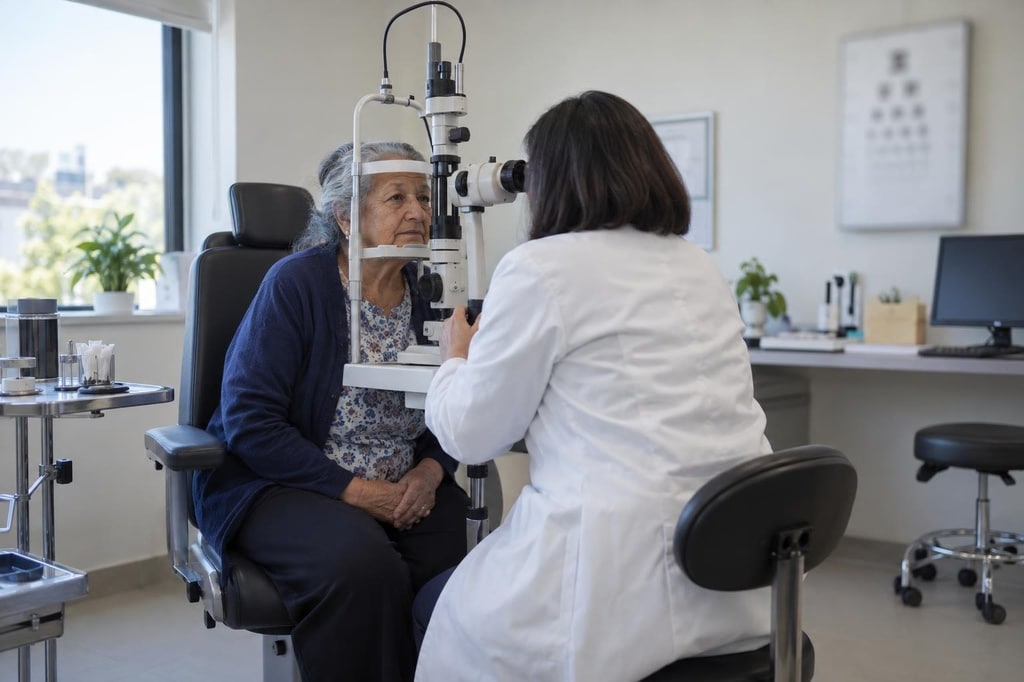
For most patients, Dr. Pham decides on timing by function. Some people have dense cataracts that don’t bother them. Others have milder ones that cut deep into their quality of life. She’ll also point out that cataracts grow slowly, so people often don’t realize what they’re missing. After surgery, vision tends to look brighter and whiter.
For patients in Warrenton, Bealeton, Marshall and the rest of Fauquier County, that evaluation happens at our Hospital Drive office with Dr. Pham or Dr. Kang. If you decide to go ahead, the detailed pre-surgical measurements are taken in one visit to our Manassas office, where the full measurement equipment is, and surgery itself is at Haymarket Surgery Center, about 25 minutes from Warrenton.
Three questions we get most
Does a cataract have to be “ripe” before surgery?
No. Dr. Pham tells patients we don’t really say “ripe” or “mature” anymore. It mostly comes down to function. If the cataract is getting in the way of driving, reading or seeing at night, that’s reason enough to talk about surgery. Surgery used to mean a hospital stay, overnight, with sandbags around your head. There’s much less to it now. And people in their seventies and eighties are more active than they used to be. They want to see the golf ball, travel and keep up with the grandkids.
Can I just wait?
If your symptoms are mild and aren’t interfering with what you do, usually yes. Updated glasses, brighter lighting and sunglasses can carry you a long way. The exception is a cataract that’s getting very dense, which your doctor will tell you about.
Can a cataract come back after surgery?
No. Dr. Pham hears this one a lot. Once the cataract is removed, it doesn’t come back. It’s a once-and-done surgery. The lens implant is made of medical-grade acrylic or plastic, and it lasts for life. Your eyes can still change over your lifetime, but that usually happens over 10 to 20 years.
When to call
If your answers to the first three questions made you a little uncomfortable, that’s worth an appointment. Dr. Pham hears the same thing from a lot of patients afterward. They wish they’d done it sooner, and they can’t remember why they were so worried.


