




Medically reviewed by Dr. Thu T. Pham, M.D., of Nova Eye Experts.
What you’d notice (nothing)
Most eye problems announce themselves. A cataract blurs things and makes headlights bloom. Dry eye burns. A retinal tear can bring sudden flashes of light and a shower of new floaters.
Open-angle glaucoma, the most common kind, does none of that. It doesn’t hurt. The eye doesn’t turn red. Your reading vision stays sharp, and so does the road straight ahead of you. The American Academy of Ophthalmology puts it bluntly: in the early stages there are no warning signs or obvious symptoms. It also estimates that about half the people who have glaucoma don’t know it.
So waiting for symptoms doesn’t work.
Why you can’t feel it happening
Glaucoma damages the optic nerve, the cable that carries everything your eye sees to your brain. The damage usually starts at the edges. Blind spots form in your side vision first, while the center stays clear.
Three things hide it from you.
It’s slow. The loss usually builds over years, so there’s no morning where something is suddenly missing.
Your eyes cover for each other. A spot one eye can’t see is often one the other eye can, so with both open you see a complete picture.
And you don’t look at your side vision. You look at things. Whatever you’re paying attention to lands in the center of your vision, which is the last part glaucoma takes.
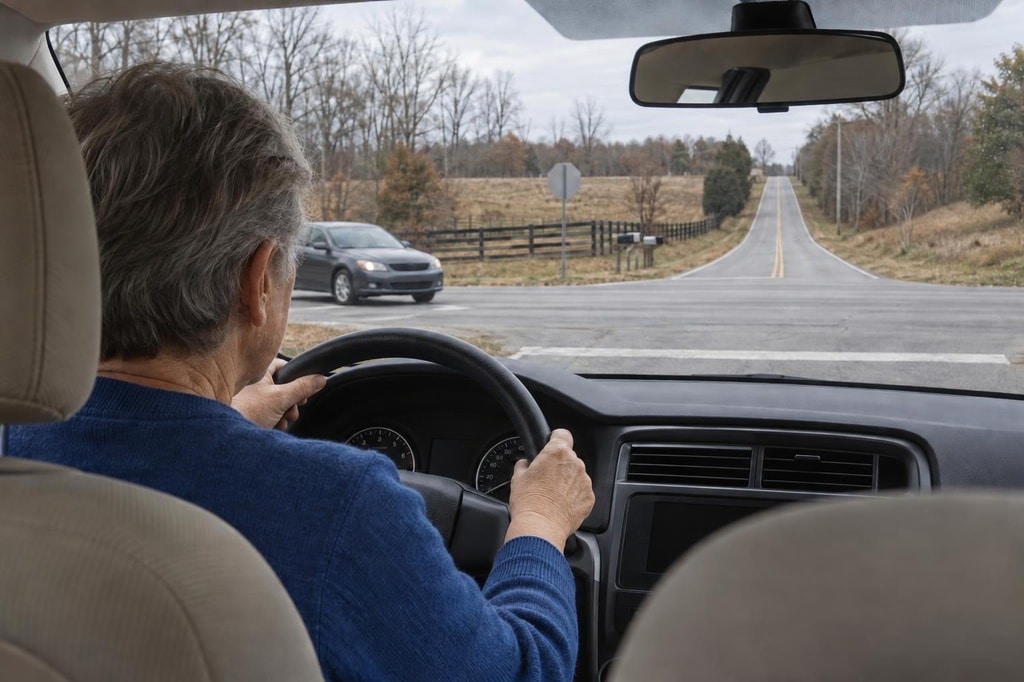
So people notice it late. Bumping a doorframe on one side. Missing a car coming from the left at a four-way stop out on a back road. Dr. Pham says some people don’t find out at all until an exam checks each eye on its own, or they happen to cover one eye for some other reason and discover how much it’s lost. By the time it’s noticeable in daily life, a meaningful amount of nerve is already gone.
Why late is the expensive part
Vision lost to glaucoma doesn’t come back. The AAO says it plainly: the damage is permanent and can’t be reversed.
What treatment does is protect what’s left. Drops, laser and surgery all lower the pressure inside the eye so the optic nerve takes less punishment, and for most people who are caught early and keep up with treatment, that’s enough to hold on to useful vision for life.
Caught at 55 with a small, early change, glaucoma usually means drops, a few visits a year, and a lot of ordinary life. Caught at 75 because a grandkid noticed you keep missing things on one side, you’re protecting a much smaller remainder. Same disease. Very different position.
Then there’s the car. Dr. Pham says driving is often what worries her glaucoma patients most. As drivers get older, the Virginia DMV can require a vision report, and she notes that patients with glaucoma may need to include visual field testing in it. Lose enough side vision and your license can be restricted. In a county where the grocery store is a drive, that matters.
The one kind that does come with symptoms
Angle-closure glaucoma is rarer, and its acute form behaves nothing like the open-angle kind. When the drainage angle inside the eye closes suddenly, pressure shoots up fast. The AAO lists what that feels like: sudden blurry vision, severe eye pain, headache, nausea and vomiting, and rainbow-colored rings or halos around lights.
That isn’t a wait-and-see situation. Call the office the same day, or get to an emergency room if it’s after hours. Sudden severe eye pain with nausea and halos is an emergency.
People of East and Southeast Asian descent have a higher risk of angle-closure glaucoma, and it can often be spotted before an attack at a regular exam, when the doctor looks at how open or narrow the drainage angle is. That matters because not all angle closure is dramatic. The chronic form, where the angle narrows gradually, may be completely silent. Dr. Pham says some patients get occasional headaches and nothing else.
Who should be paying attention
Anyone over 40, to start. Risk climbs with each decade, and in Fauquier County, where roughly one in six residents is 65 or older, that’s a lot of people.
The AAO’s list of risk factors goes well past age:
- A parent, brother or sister with glaucoma
- African, Hispanic or Asian heritage
- High eye pressure
- Diabetes, high blood pressure or migraines
- Significant nearsightedness or farsightedness
- A past eye injury
- Long-term steroid use, including some inhalers, creams and eye drops
- Thin corneas or thinning of the optic nerve, which your eye doctor would find at an exam
If more than one of those applies to you, you’re not someone who should be waiting for symptoms. There won’t be any.

A note on family: if you’ve just been diagnosed, tell your siblings and your adult children. It’s one of the most useful phone calls you’ll make that year.
A pressure reading isn’t the whole test
Plenty of people think they’ve been checked for glaucoma because they had their eye pressure measured at some point. Often that was the puff-of-air machine at a glasses appointment somewhere.
NOVA doesn’t use the air puff. Dr. Pham says it isn’t as accurate. The gold standard is Goldmann applanation, done at the slit lamp by a trained eye care specialist after a numbing drop.
Even an accurate pressure reading isn’t enough on its own. Some people have high pressure and never develop glaucoma, and some develop glaucoma with pressure in the normal range. The AAO is clear that a pressure reading alone doesn’t diagnose or rule out glaucoma. It takes a full exam.
A proper glaucoma check looks at several things, and each answers a different question:
- Eye pressure. Goldmann applanation at the slit lamp.
- The optic nerve itself. Your doctor looks directly at it through a dilated pupil for signs of damage.
- The drainage angle. Open or narrow, which is how angle-closure risk gets caught early.
- Visual field testing. You watch a central light and click a button when faint flashes appear off to the side. It maps the blind spots you can’t find on your own.
- OCT imaging. A scan that measures the thickness of the nerve fiber layer. Thinning here often shows up before any change on the visual field test, which makes it one of the earliest signals there is.
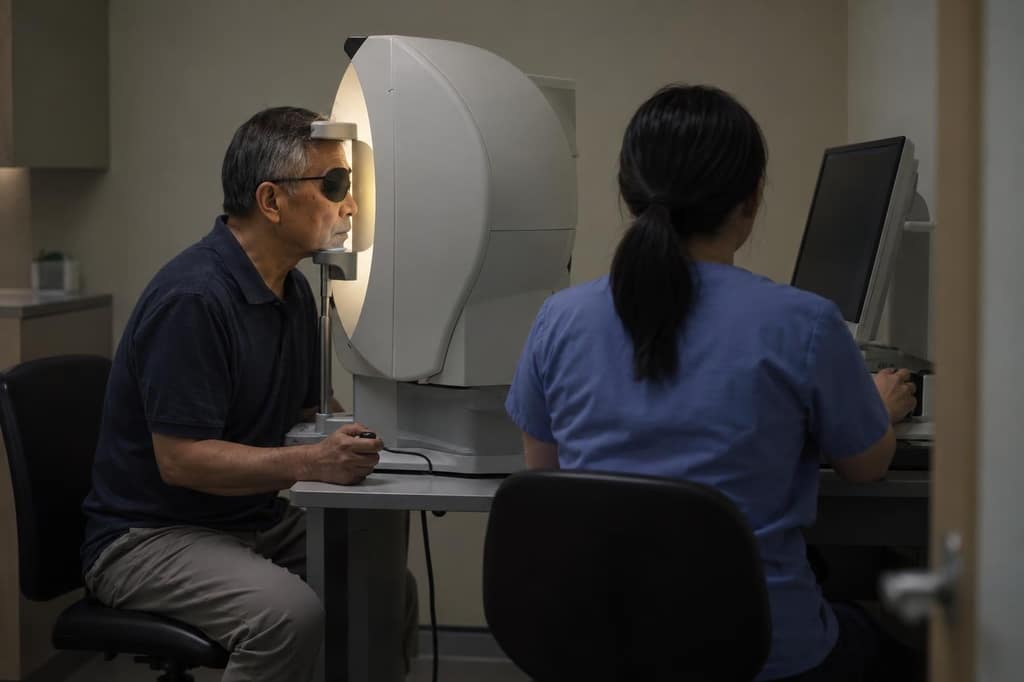
At NOVA Eye Experts, visual field testing and OCT are both done on-site at the Warrenton office on Hospital Drive, so the tests that find glaucoma early don’t require a trip to Manassas. Dr. Pham, whose clinical focus includes glaucoma detection and long-term monitoring, sees patients there, as does Dr. Kang.
How often to get checked
Dr. Pham recommends a baseline exam at 40, then a check every one to two years after that. From 65, she recommends coming in every year. And if any of the risk factors above apply to you, she wants to see you at least once a year, whatever your age.
If you can’t remember your last dilated exam, that’s your answer.
Three questions we get most
Can you feel glaucoma?
Usually not. Open-angle glaucoma, the most common form, causes no pain and no early change in how you see. Side vision is lost first and slowly, and most people don’t notice until the damage is significant. The exception is acute angle-closure glaucoma, which comes on suddenly with severe pain, nausea and halos, and is an emergency. Chronic angle closure is quieter. It may cause no symptoms at all, or only occasional headaches.
My eye pressure was normal. Does that mean I don’t have glaucoma?
Not necessarily. Glaucoma can develop with pressure in the normal range, and high pressure doesn’t always mean glaucoma. A full exam that looks at the optic nerve, and usually visual field testing and OCT imaging, is what rules it in or out.
If glaucoma is found early, will I lose my vision?
Most people who are diagnosed early and stick with treatment keep useful vision for life. Vision already lost can’t be restored, so the goal is to stop or slow further damage. That’s why the timing of the diagnosis matters so much.
Get a baseline
Dr. Pham sometimes compares glaucoma to high blood pressure: no symptoms unless it’s really high. That’s why feeling fine tells you nothing here. If you’re over 40, have a family history, or it’s been a while, an exam in Warrenton will tell you where you stand and give your doctor something to compare against for years to come.


